01The problem问题
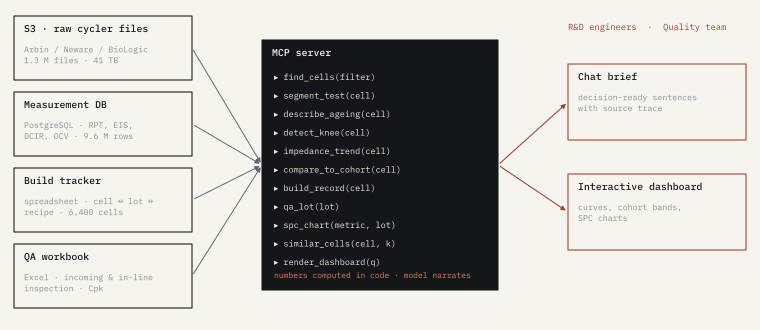
Everything needed to judge a cell existed, but in four places: raw cycler files from three vendors in S3, reference-test results in a database, the cell-to-lot-to-recipe mapping in a spreadsheet, and inspection data in the Quality team's workbook, each with its own naming convention. Answering “is this cell ageing badly, and why?” meant a half-day of manual joining before any engineering thinking started. Most questions of that kind simply went unasked.
判断一颗电芯所需的信息都存在,但分散在四处:S3 里三家设备厂商格式的原始循环文件、数据库里的 RPT 结果、表格里的电芯—批次—配方对应关系、质量团队工作簿里的检验数据——而且命名规则各不相同。要回答“这颗电芯老化是否异常、原因是什么”,得先花半天手工拼接数据,才能开始真正的工程分析。于是大多数这类问题根本没人去问。
02What we built我们搭建了什么
One schema for every cycler所有设备统一一套数据结构
Parsers for Arbin, Neware and BioLogic files into a single schema. Each test is segmented into formation, cycling, RPT, rate and pulse events. Nightly incremental sync.
为 Arbin、Neware、BioLogic 文件编写解析器,统一到同一数据结构;每个测试自动切分为化成、循环、RPT、倍率与脉冲事件;每晚增量同步。
Resolve identity across systems跨系统统一电芯身份
Cell ID ↔ lot ↔ recipe ↔ QA inspection, reconciled across three naming conventions for about 6,400 cells.
电芯编号 ↔ 批次 ↔ 配方 ↔ 质检记录,在三种命名规则之间对齐,覆盖约 6,400 颗电芯。
Typed tools, deterministic numbers类型化工具,确定性数字
Eleven MCP tools, including knee detection, impedance trend, cohort comparison and SPC charts. Each returns values computed in code together with a source trace: file, row range and calculation.
十一个 MCP 工具——包括拐点识别、阻抗趋势、同类对比、SPC 控制图等。每个工具返回由代码计算的数值,并附数据来源:文件、行范围与计算方法。
Guardrails约束机制
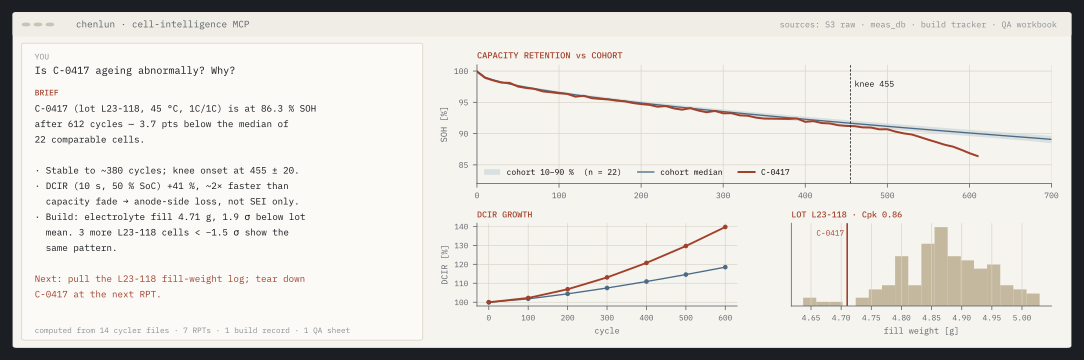
The model may only narrate tool outputs, and every figure in a brief carries a reference. When data are missing, for example when no RPT exists yet, the brief says so rather than guessing.
模型只能叙述工具输出;结论中的每个数字都带有出处。数据缺失时(例如尚无 RPT)会明确说明,而不是猜测。
03Results结果
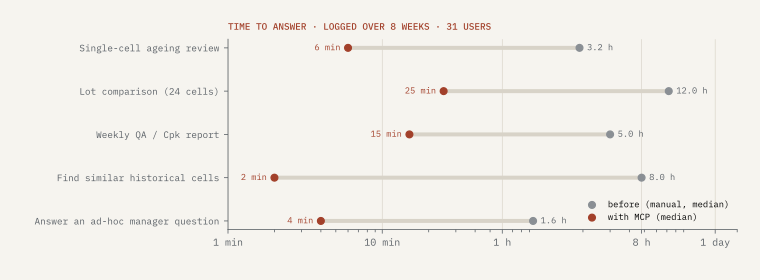
- Hours became minutes. Single-cell review went from 3.2 h to 6 min, lot comparison from 12 h to 25 min, and the weekly QA/Cpk report from 5 h to 15 min, now generated automatically.
- 从小时到分钟。单颗电芯分析 3.2 小时 → 6 分钟;批次对比 12 小时 → 25 分钟;每周质量 / Cpk 报告 5 小时 → 15 分钟(现已自动生成)。
- It found a process problem in month one. Four cells in lot L23-118 showed impedance growing about twice as fast as capacity fade. The brief traced them to low electrolyte fill weight; the filling station's Cpk was 0.86 against a target of 1.33. The station was recalibrated.
- 首月即发现工艺问题。批次 L23-118 中四颗电芯阻抗增长约为容量衰减的两倍。结论将其追溯到注液量偏低——注液工位 Cpk 为 0.86,目标值 1.33。该工位随后完成重新校准。
- Auditable by design. Engineers checked 200 briefs against source data and found no numeric errors. They found seven wording issues, which were fixed in the narration layer.
- 天然可审计。工程师对照原始数据抽检 200 份结论,未发现数值错误;发现 7 处措辞问题,已在叙述层修正。
04Limits边界
The server answers only what the data can support. It does not replace physics models; it can call them as tools. It sees only data inside the client's systems, and it has read-only access.
它只回答数据能够支撑的问题。它不替代机理模型,但可以把机理模型作为工具调用。它只能访问客户系统内部的数据,并且只有只读权限。