01The problem问题
The cell was qualified at 1.25C constant current. The team had already tried twice to raise the current empirically: one profile plated lithium at 15 °C within 50 cycles, the other lost 6 % more capacity than the baseline by cycle 400. Each attempt cost about ten weeks of cycling, and the customer's decision gate was four months away. There was room for one more attempt, and it had to work.
该电芯以 1.25C 恒流完成认证。团队此前两次凭经验提高电流:一次在 15 °C 下 50 次循环内即出现析锂,另一次在 400 次循环时比基线多衰减 6 %。每次尝试要消耗约十周循环测试,而客户的决策节点只剩四个月——只剩一次机会,而且必须成功。
The underlying difficulty is that plating depends on the anode's local potential, which is not visible in the cell voltage. A higher current is safe at low state of charge and unsafe near the graphite plateaus. A single constant current is limited by the worst point.
根本难点在于:析锂取决于负极的局部电位,而这一电位无法从电芯端电压看出。低 SoC 时的大电流是安全的,到石墨平台区附近就不安全了。单一恒流只能迁就最危险的那个点。
02What we did我们做了什么
Parameterise from the client's own cells用客户自己的电芯做参数化
Half-cell GITT and rate tests on harvested electrodes, EIS at five temperatures, entropic coefficients from potentiometric measurement. 41 parameters: 29 measured, 12 from literature with stated ranges.
拆解电极制成半电池做 GITT 与倍率测试,五个温度下测 EIS,电位法测熵热系数。共 41 个参数:29 个实测,12 个取自文献并注明取值范围。
Build a plating-aware model建立析锂判据模型
A DFN electrochemical model coupled to a lumped thermal model. The plating indicator is the anode potential vs Li/Li⁺ at the separator, where it is lowest.
DFN 电化学模型耦合集总热模型。析锂判据取负极在隔膜侧的电位(vs Li/Li⁺)——这是负极电位最低的位置。
Measure what the model predicts实测模型的预测量
Eight 21700 cells were built with a lithium-plated copper reference wire so the anode potential could be read directly during charging. These cells are the ground truth for the plating constraint.
制作 8 颗内置镀锂铜丝参比电极的 21700 电芯,在充电过程中直接读取负极电位,作为析锂约束的“真值”。
Optimise under real constraints在真实约束下优化
We searched multi-step constant-current profiles for the shortest time subject to: anode potential ≥ +18 mV, surface temperature ≤ 45 °C, and no more than four steps, so the existing BMS could run it. Repeated at 15, 25 and 35 °C to give a temperature table.
在以下约束下搜索多段恒流曲线的最短时间:负极电位 ≥ +18 mV、表面温度 ≤ 45 °C、不超过四段(现有 BMS 可直接执行)。在 15、25、35 °C 分别求解,形成温度查表。
03Results结果
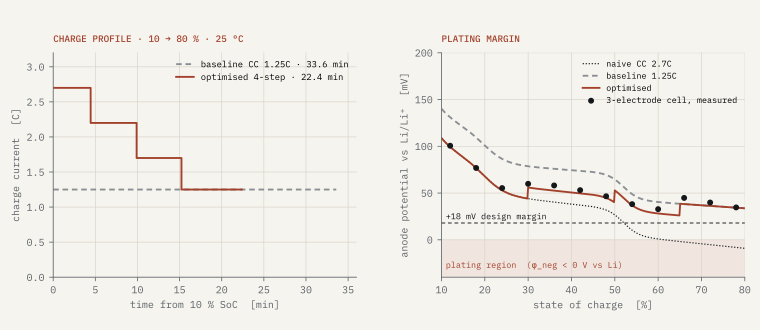
- 10→80 % in 22.4 minutes at 25 °C, down from 33.6 (−33 %). 27.1 minutes at 15 °C, where the table derates the first two steps.
- 25 °C 下 10→80 % 仅需 22.4 分钟,原为 33.6 分钟(−33 %)。15 °C 下查表自动降低前两段电流,用时 27.1 分钟。
- Lowest measured anode potential +29 mV (model +26 mV), above the +18 mV margin. Peak surface temperature 41.8 °C.
- 实测最低负极电位 +29 mV(模型 +26 mV),高于 +18 mV 裕度。表面最高温度 41.8 °C。
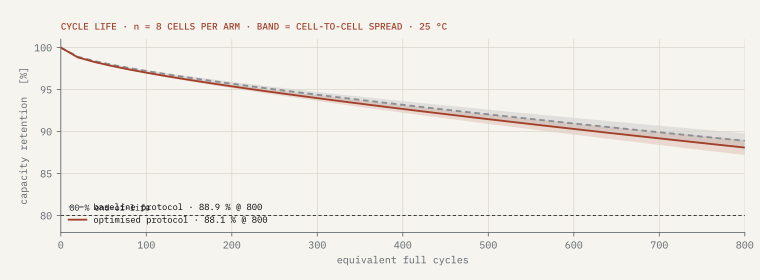
- No plating on teardown. Two cells opened after 300 cycles showed no metallic lithium on the anode, by visual inspection or SEM.
- 拆解未见析锂。300 次循环后拆解两颗电芯,目视与 SEM 均未在负极表面发现金属锂。
04Limits of validity适用边界
Validated for 15–35 °C cell temperature, 10–80 % SoC, and cells from fresh down to 85 % SOH. Below 15 °C the table falls back to a derated 1.25C profile. Not validated for cells from the client's new electrode line, which uses a different graphite.
已验证范围:电芯温度 15–35 °C、SoC 10–80 %、SOH 从新电芯到 85 %。低于 15 °C 时查表退回降额的 1.25C 曲线。客户新电极产线采用了不同的石墨,其电芯不在验证范围内。