01The problem问题
A temperature gradient inside a cell makes some of its electrode age faster than the rest. By Arrhenius scaling, 10 K roughly doubles the local ageing rate near the hot end. The client had already improved pack-level cooling, but that cannot fix a gradient that starts inside the cell.
电芯内部的温度梯度会让一部分电极比其余部分老化得更快——按阿伦尼乌斯规律,高温端相差 10 K,局部老化速率约翻一倍。客户已经改进了电池包层面的冷却,但源自电芯内部的温差无法靠包级冷却解决。
02What we did我们做了什么
Instrument the baseline cell为基线电芯布置测点
12 thermocouples plus IR thermography at 1C, 2C and 3C. We also measured current-collector sheet resistance and heat generation with isothermal calorimetry.
布置 12 个热电偶并配合红外热成像,测试 1C、2C、3C;同时测量集流体方阻,并用等温量热仪测量产热。
Model where the current actually flows还原电流的真实路径
The current-collector potential is solved in 2D and coupled to a 1D electrochemical model at every point. Heat conduction is 3D and anisotropic: 28 W/m·K in-plane, 0.9 W/m·K through-plane.
二维求解集流体电位分布,并在每个位置耦合一维电化学模型;三维各向异性导热(面内 28 W/m·K,厚度方向 0.9 W/m·K)。
Compare 18 variants比较 18 个方案
Variables: tab position (same side or opposite), tab width (40–80 mm), tab cooling versus face cooling, and current-collector thickness.
变量包括:极耳位置(同侧 / 两端)、极耳宽度(40–80 mm)、极耳冷却 vs 大面冷却,以及集流体厚度。
Build and measure the winner制作并实测最优方案
The client built six prototype cells of the chosen design, instrumented the same way as the baseline.
客户按选定方案制作 6 颗样品电芯,采用与基线相同的测点布置。
03Results结果
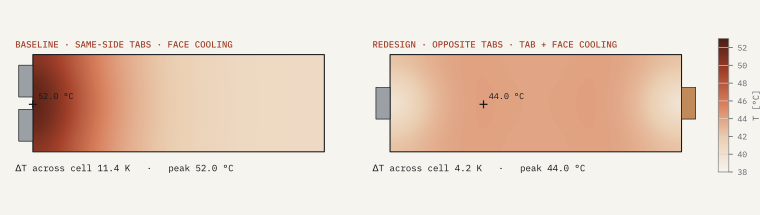
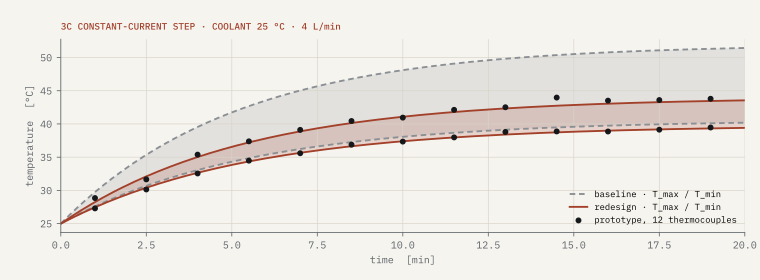
- ΔT across the cell fell from 11.4 K to 4.2 K in the model; 4.6 K was measured on the prototypes. The peak fell from 52.0 °C to 44.0 °C.
- 模型预测电芯内温差从 11.4 K 降至 4.2 K,样品实测 4.6 K;最高温度从 52.0 °C 降至 44.0 °C。
- 0.4 K RMSE across all 12 thermocouples on the prototype cells.
- 样品电芯 12 个热电偶上的预测误差 RMSE 为 0.4 K。
- No energy penalty. Tab width stayed at 60 mm and the cell envelope is unchanged. The projected SOH spread across the pack after 1,500 cycles narrows from 3.1 to 1.2 points.
- 无能量损失。极耳宽度保持 60 mm,电芯外形不变。预计 1,500 次循环后,电池包内电芯 SOH 离散度从 3.1 个百分点收窄到 1.2。
04Limits of validity适用边界
Validated for 1C–3C, coolant at 15–35 °C, and fresh cells. Heat generation in aged cells was not measured, so the pack-level SOH projection is an estimate.
已验证范围:1C–3C、冷却液 15–35 °C、新电芯。老化电芯的产热未做测量,因此电池包层面的 SOH 离散预测属于估算。