Physics-based battery simulation, from particles to cells.
We connect particle-scale electrochemistry to full-cell multiphysics, and use it to design fast-charge protocols, predict ageing, and build the simulation and data workflows your engineers work in every day.
One parameter set, three scales一套参数,三个尺度
PARTICLE → ELECTRODE → CELL
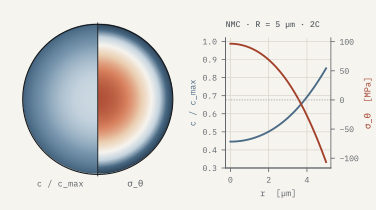
Particle level
Solid-state diffusion, phase transitions, particle cracking and interfacial kinetics — used to screen active materials on mechanism, not correlation.
颗粒尺度
固相扩散、相变、颗粒开裂与界面反应动力学。用于从机理判断活性材料与配方方向。
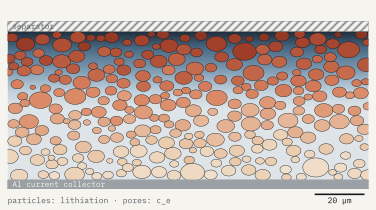
Electrode level
Porosity, tortuosity, coating thickness and calendering — how process choices set rate capability and the lithium-plating window.
电极与极片尺度
孔隙率、曲折度、涂布厚度与压实密度,如何决定倍率性能与析锂窗口。
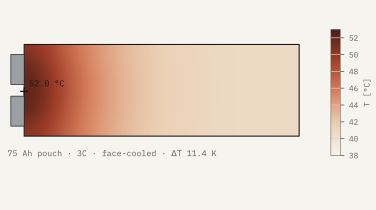
Cell level
Coupled electro-thermal-mechanical models: tab and cooling design, temperature rise, and performance over real duty cycles.
电芯级多物理场
电-热-力耦合模型:极耳与散热设计、温升,以及真实工况下的性能表现。
The three scales share one parameter set: values calibrated at the particle scale carry into the electrode and cell models, so a change in formulation or process stays traceable through to cell-level performance.
三个尺度共用一套参数体系:颗粒尺度标定的参数直接进入电极与电芯模型,配方或工艺的改动可以一路追溯到电芯性能。
Services服务
ENGAGEMENTS — PROJECT, RETAINER, OR EMBEDDED
Particle-level modelling颗粒尺度建模
S-01 · CASE 05Diffusion and stress models, phase-change pathways, SEI growth kinetics for mechanism-level material assessment.
扩散与应力模型、相变路径、SEI 生长动力学,用于材料的机理级评估。
Electrode & coating simulation极片与涂层仿真
S-02 · CASE 04Microstructure-resolved and homogenised models linking loading, porosity and calendering to rate and plating risk.
微观结构与均质化模型,将面容量、孔隙率、压实与倍率、析锂风险联系起来。
Cell-level multiphysics电芯级多物理场
S-03 · CASE 06Electro-thermal-mechanical models of pouch, cylindrical and prismatic cells under real duty cycles.
软包、圆柱与方形电芯在真实工况下的电-热-力耦合模型。
Fast-charge protocol design快充协议开发
S-04 · CASE 01Charge current profiles optimised against plating and temperature limits, then validated on your cells.
在析锂与温度边界约束下优化充电电流曲线,并在客户电芯上验证。
Ageing & lifetime prediction老化与寿命预测
S-05 · CASE 02Degradation-mode models with knee detection, calibrated on your cycling data and extrapolated to field duty cycles.
基于衰减机理的模型与拐点识别,用客户循环数据标定,并外推到实际工况。
MCP servers for battery data电池数据 MCP 服务
S-06 · CASE 03AI access to your own test data, so engineers ask questions in plain language. See section 03.
让 AI 接入你们自己的测试数据,工程师用自然语言提问。详见第 03 节。
Data platforms & automation数据平台与自动化
S-07Cycler-file ingestion, feature extraction and reporting pipelines that replace manual spreadsheet work.
充放电机数据接入、特征提取与自动报告流水线,替代手工表格分析。
Consulting & training咨询与培训
S-08Model reviews, DoE planning, and hands-on courses for in-house simulation teams.
模型评审、试验设计规划,以及面向客户内部仿真团队的实操培训。
Ask your cells a question向你的电芯提问
MCP SERVER — BUILT ON YOUR OWN MEASURED DATA
It lets a battery engineer ask questions about cells in plain English and get answers computed from the actual measured data.
让电池工程师用自然语言提问,答案全部由真实测量数据计算得出。
The information needed to judge a cell is scattered — raw cycler files in S3, a measurement database, a tracker spreadsheet, and the Quality team's workbook. Answering “is this cell aging badly, and why?” used to mean opening four systems and doing the analysis by hand.
判断一颗电芯所需的信息是分散的:S3 里的原始循环文件、测量数据库、跟踪表格,以及质量团队的工作簿。要回答“这颗电芯老化是否异常、原因是什么”,过去要打开四个系统并手工分析。
It reads the raw test files and interprets them: segments them into meaningful events (formation, cycling, rate tests, pulses), then describes what happened in engineering language — where capacity was stable, where it started declining, whether there's a knee, whether the impedance is growing faster than the capacity is fading. It cross-links that to how the cell was built and what the Quality inspections found, and it can compare a cell against similar ones from history.
它读取原始测试文件并加以解释:先切分为有意义的事件(化成、循环、倍率测试、脉冲),再用工程语言描述发生了什么——容量在哪一段稳定、从哪里开始衰减、是否出现拐点、阻抗增长是否快于容量衰减。它把这些与电芯的制造信息、质量检验结果交叉关联,并可与历史上相似的电芯做对比。
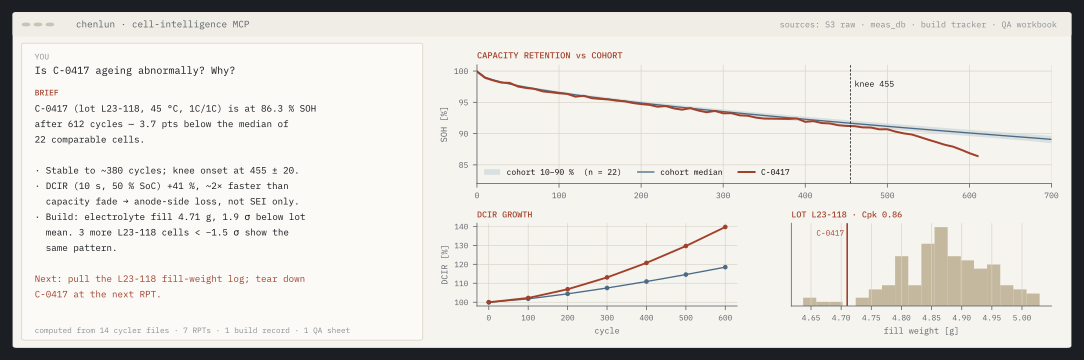
A short written brief in chat — decision-ready sentences, not data dumps — and an interactive dashboard for looking at the curves.
一是对话里的简短结论——可直接用于决策的句子,而不是数据堆叠;二是用于查看曲线的交互式看板。
R&D engineers asking about cell performance, and the Quality team watching process control (Cpk, control charts, defects, lot traceability).
研发工程师关注电芯性能;质量团队关注过程控制(Cpk、控制图、缺陷、批次追溯)。
The numbers are always computed by code, and the model only narrates them. That keeps the answers auditable — you can trace any figure back to measured data.
所有数字都由代码计算,模型只负责叙述。因此每一个数字都可以追溯回原始测量数据。
Read the deployment case: four systems, 31 users, 3.2 h → 6 min →查看落地案例:四个系统、31 位用户、3.2 小时 → 6 分钟 →
How we validate验证方法
EVERY MODEL SHIPS WITH ITS BENCHMARK
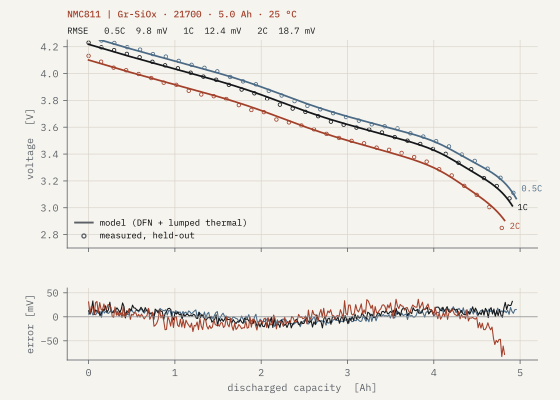
Parameterisation
Parameters come from your own measurements, or from a documented literature source with its uncertainty stated.
参数化
参数来自客户自有测量,或来自有出处的文献值,并明确标注不确定度。
Held-out validation
Calibration and validation datasets are kept separate. We report error against data the model never saw.
留出验证
标定与验证数据集严格分开,误差指标基于模型未见过的数据。
Stated limits of validity
Each model comes with the C-rate, temperature and SoC window in which it was validated — and where it should not be trusted.
明确适用边界
每个模型都给出经过验证的倍率、温度与 SoC 区间,以及不应外推的范围。
Handover you can run
Deliverables include the model, the scripts, and a report your team can reproduce line by line.
可复现的交付
交付内容包括模型、脚本与报告,客户团队可以逐步复现结果。
Selected work案例研究
CASE STUDIES — CLIENT NAMES WITHHELD案例研究 — 客户名称已隐去
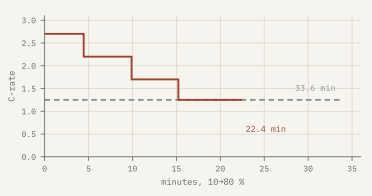
10→80 % in 22 minutes, with no added plating risk10→80 % 充电 22 分钟,析锂风险不增加
NMC811 21700 cell. A plating-aware model and reference-electrode cells gave a four-step profile that cut charge time by a third, with the same cycle life.
NMC811 21700 电芯。基于析锂判据的模型加三电极电芯验证,得到四段式充电曲线:充电时间缩短三分之一,循环寿命不变。
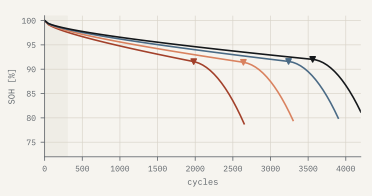
Knee onset predicted from the first 300 cycles用前 300 次循环预测衰减拐点
96 LFP 280 Ah cells. A degradation-mode model predicted where fade turns non-linear, tested on 32 cells it never saw.
96 颗 LFP 280 Ah 电芯。基于衰减机理的模型预测容量衰减何时转为非线性,并在 32 颗从未见过的电芯上检验。
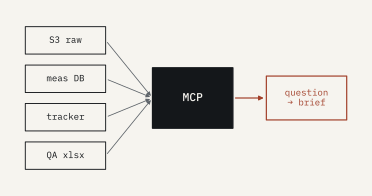
Four data systems, one question box四个数据系统,一个提问框
A cell R&D centre's cycler files, measurement DB, build tracker and QA workbook, joined behind one MCP server used by 31 engineers.
某电芯研发中心的循环数据、测量数据库、制造跟踪表与质量工作簿,统一接入一个 MCP 服务,31 位工程师日常使用。
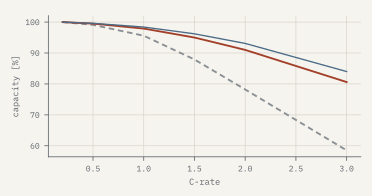
A thicker cathode that keeps its 2C rate加厚正极,2C 倍率不打折
NMC622 pouch cell. CT-measured tortuosity and a two-layer porosity design took loading from 3.4 to 4.2 mAh/cm² without losing rate.
NMC622 软包电芯。基于 CT 实测曲折度与双层孔隙梯度设计,面容量从 3.4 提升到 4.2 mAh/cm²,倍率性能基本保持。
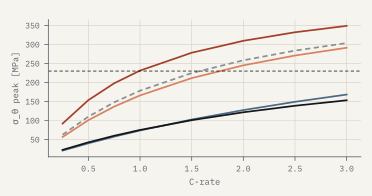
Two cathode candidates ruled out before a single cell was built在造电芯之前,先排除两个正极候选
A chemo-mechanical particle model ranked four single-crystal NMC candidates by cracking risk. SEM after 300 cycles confirmed the order.
颗粒级化学-力学模型按开裂风险对四种单晶 NMC 候选材料排序,300 次循环后的 SEM 截面结果与排序一致。
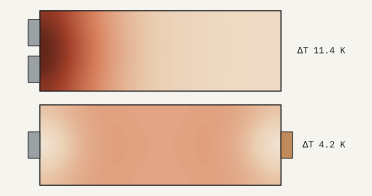
In-cell temperature spread cut from 11.4 K to 4.2 K电芯内部温差从 11.4 K 降到 4.2 K
75 Ah pouch cell for commercial vehicles. A 3D electro-thermal model traced the hot spot to current crowding at same-side tabs.
商用车 75 Ah 软包电芯。三维电-热耦合模型定位到热点来自同侧极耳处的电流集中。
Send us a cell and a question.
Tell us the cell chemistry, the format, and what you need to decide. We reply with the modelling approach we would use, the data we would need from you, and a scope.
带上一个电芯和一个问题联系我们。
告诉我们体系、形状与需要做的决策。我们会回复建议的建模路径、需要你们提供的数据,以及项目范围。